Understanding Mupi Signage and Roadside Mockup Templates: A Complete Guide
Outdoor advertising has long been a cornerstone of brand visibility, but few formats are as instantly recognizable—or as strategically effective—as Mupi signage. Whether you are a marketing professional, a small business owner, or a designer looking to present your work convincingly, understanding what Mupi signage is and how roadside mockup templates bring these concepts to life can transform the way you approach visual communication in public spaces.
This article explores the fundamentals of Mupi signage, its real-world applications, and the practical role of mockup templates in modern design workflows. By the end, you will have a clear picture of why this advertising format remains a powerful tool—and how you can use it effectively.
What Is Mupi Signage?
The term Mupi originates from the French phrase Mobilier Urbain Publicitaire, which translates to "urban advertising furniture." In practice, a Mupi is a large, backlit outdoor display unit typically installed on sidewalks, in pedestrian zones, at bus stops, or along busy roadways. These structures are designed to house advertising posters or digital screens in a durable, weather-resistant frame.
Mupi signs are distinct from traditional billboards in several important ways:
- Size and proportion: Mupi units are usually taller than they are wide, offering a vertical canvas that aligns naturally with how people walk or wait in public spaces.
- Lighting: Almost all Mupi signage is internally illuminated (backlit), making it highly visible at night and in low-light conditions.
- Placement: They are positioned at eye level or slightly above, which invites closer engagement compared to elevated billboards.
- Transit integration: Many Mupi units are located in transit shelters or near pedestrian crossings, capturing the attention of commuters and foot traffic.
These features combine to create a high-impact advertising medium that is both intrusive in the best possible way and contextually relevant to urban life.
Why Mupi Signage Matters in Modern Advertising
In an era dominated by digital ads, social media feeds, and streaming platforms, one might wonder whether physical outdoor advertising still holds value. The answer is a resounding yes—and Mupi signage is a prime example of why.
Unavoidable Visibility
Unlike online ads that can be blocked, skipped, or scrolled past, Mupi signs occupy physical space in the real world. Pedestrians and drivers encounter them naturally as part of their daily commute or routine. This unavoidable visibility builds brand recall through repeated, low-effort exposure—a principle that marketing psychologists call mere exposure effect.
High-Quality Presentation
Backlit Mupi displays render colors vibrantly and create a sense of prestige. When a brand appears on a well-lit, professionally produced Mupi panel, it conveys quality, permanence, and legitimacy. This is especially valuable for luxury brands, real estate developers, cultural institutions, and public service campaigns.
Local Targeting
Mupi signage is inherently location-specific. A brand can customize its message for a particular neighborhood, transit route, or commercial district. This geographic precision allows advertisers to reach audiences where they live, work, and shop, increasing relevance and conversion potential.
Complementing Digital Campaigns
Savvy marketers use Mupi signage to support online efforts. For example, a roadside Mupi might feature a QR code, a hashtag, or a simple URL that bridges the physical ad to a digital landing page. This creates a seamless omnichannel experience that reinforces the campaign across touchpoints.
What Is a Mupi Signage Roadside Mockup Template?
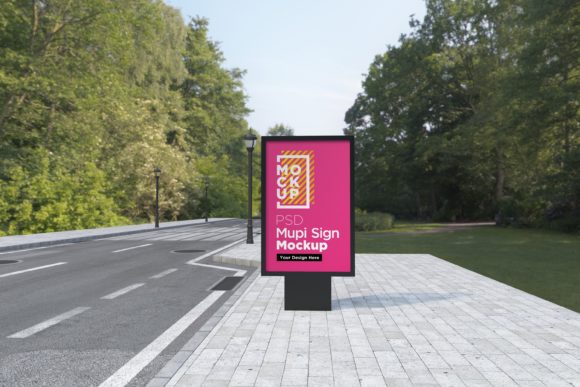
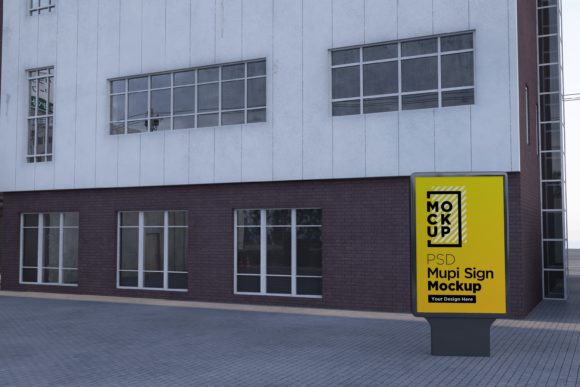
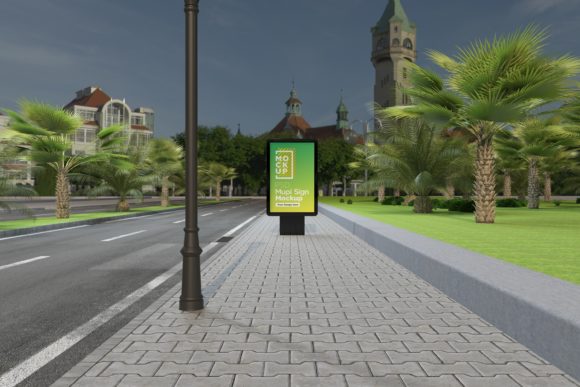
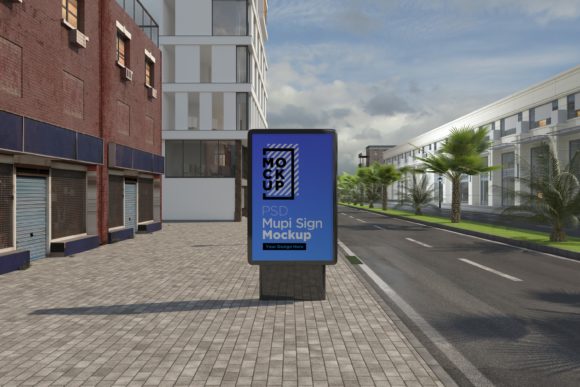
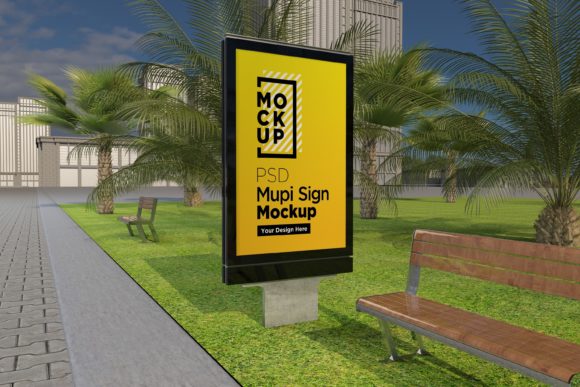
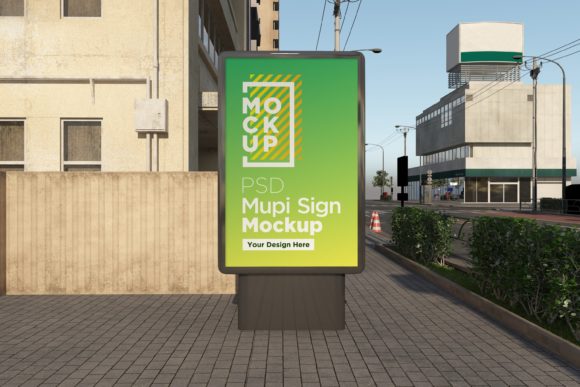
A roadside mockup template is a digital design file—often created in Photoshop, Sketch, or similar tools—that simulates how a Mupi advertisement would look in a real outdoor environment. These templates typically include:
- A photograph of an actual roadside location (e.g., a sidewalk, bus shelter, or street corner) with a Mupi unit in place.
- A smart object layer where the designer can insert their own artwork, logo, or poster design.
- Adjustable lighting, shadowing, and perspective effects that make the inserted artwork look natural and convincing.
Mockup templates serve a critical role in the design and approval workflow. Rather than imagining how a flat poster will appear on a three-dimensional structure, designers and clients can visualize the final result in context before any printing or installation occurs.
Client Presentations
When presenting a campaign idea to a client or stakeholder, a realistic mockup is far more persuasive than a flat digital file. Seeing the advertisement placed on a busy street, with natural lighting and environmental cues, helps the client envision the real-world impact of the design. This reduces ambiguity, builds confidence, and accelerates decision-making.
Design Validation
Mockup templates allow designers to test how their work behaves in context. Will the text be legible from a distance? Does the color palette stand out against the background? Are the proportions correct? These questions are answered much more accurately with a contextual mockup than with a standalone digital artwork.
Portfolio Building
For freelance designers and creative agencies, presenting work in realistic roadside mockups elevates the professionalism of a portfolio. A collection of Mupi signage mockups demonstrates industry awareness, attention to detail, and the ability to design for physical media—all of which are attractive to potential clients and employers.
Cost and Time Efficiency
Producing a physical prototype of a Mupi sign is expensive and time-consuming. Mockup templates eliminate that need entirely. Designers can iterate, revise, and experiment with different layouts, colors, and messages within minutes, all while maintaining a high degree of realism. This agile workflow saves both time and budget.
Practical Examples of Mupi Signage in Action
To understand the versatility of Mupi signage, consider these real-world scenarios:
- Transit shelter advertising: A city's public transport authority uses Mupi units to display route maps, service updates, and sponsored ads. A mockup template helps the authority preview how informational content coexists with commercial messaging.
- Brand launch campaigns: A new beverage company wants to create buzz in metropolitan areas. They design a series of bold, visually striking Mupi posters and use a roadside mockup template to ensure the designs are legible and impactful at street level.
- Non-profit awareness: An environmental organization runs a campaign about ocean pollution. Their Mupi signage features compelling imagery and a call-to-action with a QR code. The mockup allows them to test QR code placement for easy scanning by passersby.
- Real estate developments: A luxury apartment complex uses Mupi signage near the construction site to showcase renderings, floor plans, and contact information. The mockup helps the developer and marketing team align on the visual hierarchy before printing.
These examples illustrate how Mupi signage functions as more than just a large poster—it is a strategic communication tool tailored to its environment.
Common Misunderstandings About Mupi Signage
Given its ubiquity, several misconceptions persist about Mupi signage. Let's clarify a few:
Misunderstanding 1: Mupi Signage Is Outdated
Some believe that outdoor physical advertising is declining. In reality, the Mupi format has evolved to include digital screens (digital Mupi), interactive elements, and even real-time data integration. Far from being outdated, it is adapting to the digital age while retaining its core advantage: physical presence.
Misunderstanding 2: Mockup Templates Are Only for Beginners
Experienced designers also rely on mockup templates. The value is not in technical skill but in speed and context. Even the most seasoned creative professional benefits from seeing their work in a realistic setting before finalizing it. Mockups are a professional productivity tool, not a crutch.
Misunderstanding 3: Mupi Advertising Is Too Expensive for Small Businesses
While prime roadside locations command premium rates, many cities offer affordable Mupi advertising in less central areas. Small businesses can target specific neighborhoods with modest budgets. Moreover, using a mockup template for planning and pitching can make the entire process more cost-effective.
Misunderstanding 4: All Mupi Mockups Look the Same
Good mockup templates offer variety in perspective, lighting conditions, time of day, and environmental context. A well-selected mockup can dramatically change how a design is perceived. Choosing the right template is an important design decision in its own right.
How Mupi Signage Fits into Modern Life and Business
In an increasingly screen-saturated world, Mupi signage offers a tangible counterpoint. It exists in the physical landscape, competing for attention not with algorithms but with the environment itself. For businesses, it provides a way to establish a local presence without relying solely on digital channels. For cities and municipalities, it offers a source of revenue and a platform for civic messaging.
From a creative standpoint, Mupi signage challenges designers to think about scale, legibility, materiality, and context in ways that screen-based design does not. Designing for a backlit roadside display requires consideration of viewing distance, ambient light, weather conditions, and even the angle of approach. These constraints can spark creative solutions that enrich a designer's overall skill set.
For educators and students, mockup templates are invaluable learning tools. They allow learners to experiment with real-world constraints and receive feedback on contextual appropriateness. This bridges the gap between classroom projects and professional practice.
Practical Tips for Using a Roadside Mockup Template
If you are new to working with Mupi signage mockup templates, the following steps will help you get started:
- Choose a high-quality template: Look for templates with realistic lighting, multiple angles, and high-resolution backgrounds. The more convincing the base image, the better your final presentation will be.
- Use smart objects correctly: Most Photoshop mockups use smart object layers. Double-click the smart object icon, paste your design, save, and return. This preserves the perspective and scaling automatically.
- Match your design to the context: If the mockup shows a rainy street or a sunny afternoon, consider how your design's color temperature and contrast interact with that environment. Small adjustments can make a big difference in realism.
- Test legibility at different scales: Zoom out to simulate the view of a passerby. If key text is too small or too faint, revise your layout. Legibility from a distance is the single most important factor in effective Mupi signage.
- Present multiple variations: Show your client or team a few different mockup angles—one close-up, one from across the street, and one with environmental context. This tells a complete story about how the ad will perform.
Conclusion
Mupi signage remains a powerful and relevant advertising medium in an increasingly digital world. Its physical presence, strategic placement, and high-visibility design make it an indispensable tool for brands, agencies, and public institutions alike. Meanwhile, roadside mockup templates have democratized the design process, enabling creators of all skill levels to produce professional, context-rich presentations that win approval and drive results.
Whether you are planning your first outdoor campaign or refining your portfolio, understanding both the medium and the tools that support it will give you a distinct advantage. By combining creative design with realistic visualization, you can create Mupi signage that not only captures attention but also communicates with clarity and purpose.
As you move forward, remember that the best Mupi advertising does not simply occupy space—it belongs there. And with the right knowledge and the right template, you can ensure your work always feels at home on the roadside.